an interview with Matthew S (Illegal Art + Myth Math)
It was 2006 and I was sixteen in Burlington, Vermont. If you needed to track me down, you could generally find me in the sale section of Urban Outfitters, looking for a $4 t-shirt that would make me feel 2% cooler than I was. I had an older sister and she was cooler than me. She still is, but she used to be too. Our tastes didn't often align—if we're talking '00s music culture in terms of The Bens, I was more of a Ben Gibbard, and she was more of a Ben Harper—but sometimes we were both into the same thing at the same time.
And she was the one who put me on to Girl Talk, pulling up the classic mashup album Night Ripper on our family computer, via a website called Illegal Art. She'd heard about it from friends and thought I'd like it too. She was very right—Girl Talk is probably still in my top 10 favorite artists of all time. And at a time when I understood mp3s to be either shiny official purchases from the iTunes store, or else dubious scraps carved from the Limewire/Napster corpus, the idea that there could be pay-what-you-wish downloads from a legitimate label felt wild to me.
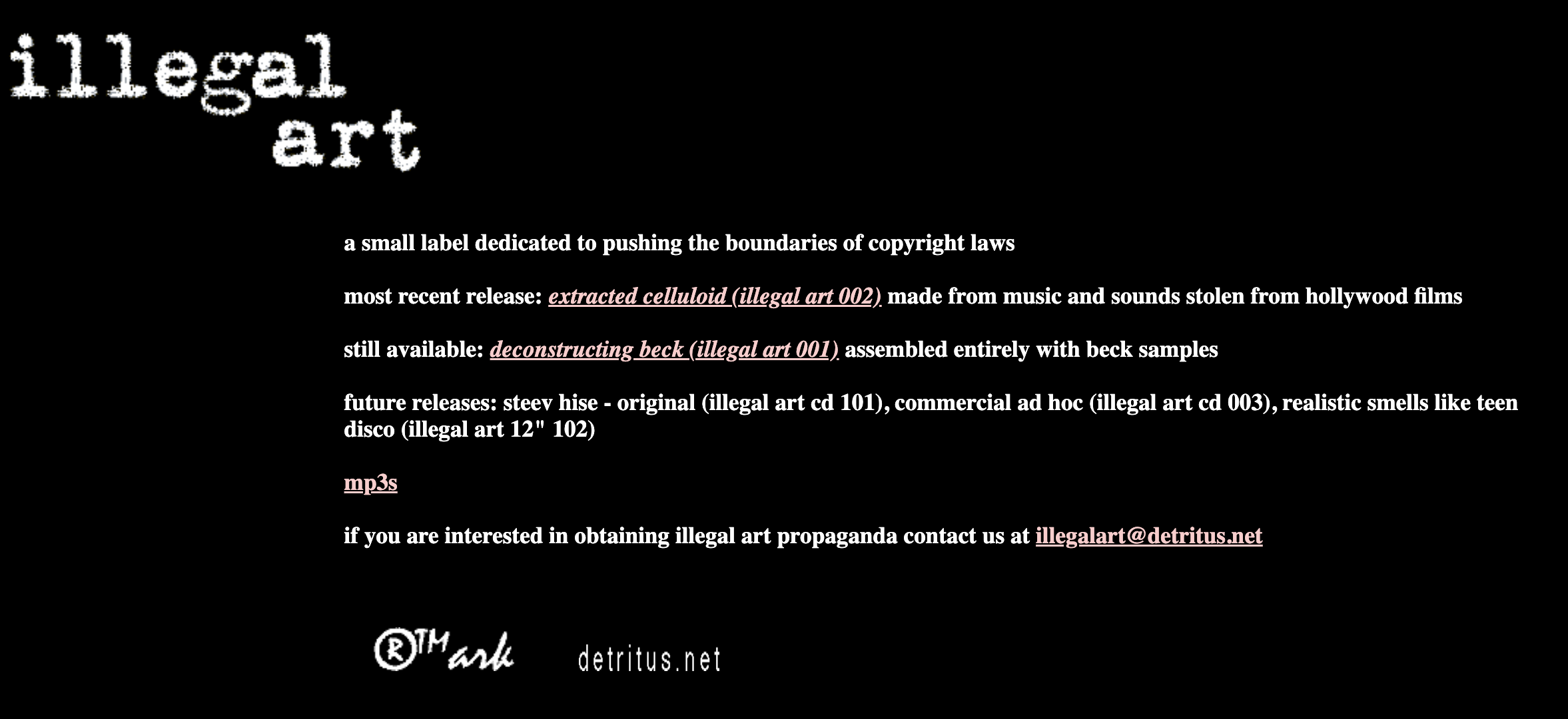
Illegal Art was founded in 1998, a label devoted to sample-based music whose first release was Deconstructing Beck, an album made of sliced, diced, and re-animated Beck songs. The press release for that album included a quote from the pseudonymous Illegal Art founder Philo T. Farnsworth, who described the label as "an outlet for artists interested in exploring an illegal palette. Corporations invade our lives with product but forbid us to use it—in our art, or in any way they don't want. This just doesn't make sense." What began as a very late '90s subversion of consumerism evolved into a more fluid exploration of how sampling could thrive in an increasingly digital music world; Illegal Art put out over 40 releases, including albums from artists like Steinski and People Like Us, then went on hiatus back in 2012.
Now the label is getting a reboot, led by Matthew S., the former Philo T. Farnsworth. Matthew is not just the label brass—he's a musician himself, formerly recording as Oh Astro and now making new music as Myth Math. Illegal Art has a few fresh projects in the pipeline, including a new Girl Talk project called Don't Come To My House Sharing Your Location (great name) featuring underground rappers Michael Christmas and Chris Crack, and the Myth Math EP Tongues, which is out now, and contains some really beautiful, sensitive, off-kilter electronic music. I love the song "Lift," which has a quietly positive energy / sentiment that will please anyone who has I Enjoy Music mindset.
 Bandcamp New & Notable Apr 29, 2024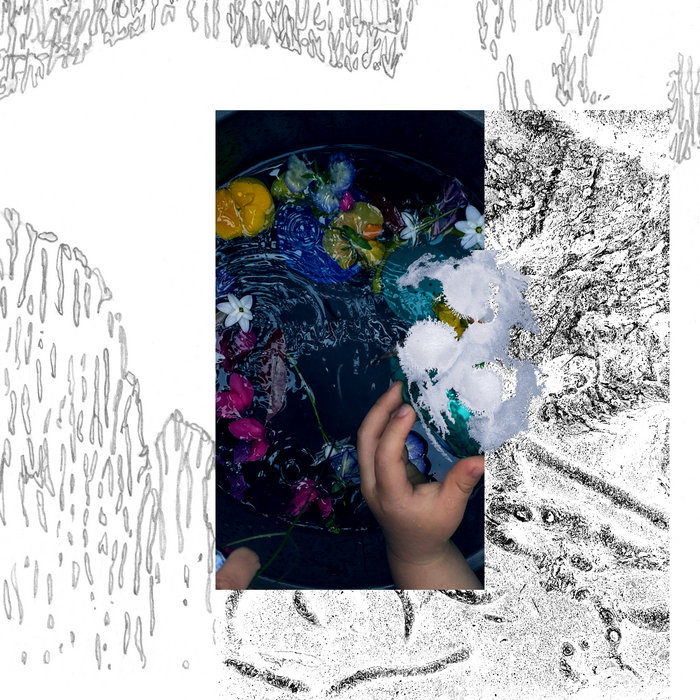
I was lucky enough to chat with Matthew about the label re-launch, getting out of experimental music mindset, the changing promo landscape, and how young people have been influencing his taste. Read on for the interview, which has been edited for length + clarity, of course...
[Molly Mary O'Brien] How does it feel to be kicking everything back off after all these years?
[Matthew S.] It's exciting, but it's also slightly overwhelming. I'm quickly reminded of why I stopped doing it. But no, it's fun, and I'm excited for the four releases we have scheduled so far.
In terms of sheer workload with the label operations, is this all you?
Yeah, it's mostly me. If it's low volume, then I just do it myself. There's been times, particularly with the Girl Talk vinyl reissues where we're shipping hundreds at a time, when I need to get help. It's at the level where there's enough to do that I could use help, but there's not enough to hire someone, or by the time I show them what to do, I've already spent the time doing it.
Ah, yes, I'm familiar with that limbo of labor where you're like, I might as well just do it. I'd love to first take it back to the decision to put Illegal Art on hiatus back in 2012. What was on your mind when you stopped?
The primary reason was that I never left my job as a professor. That's a full-time job, and the label was turning more and more into another full-time job. And connected to both of them is my creative work. Since I teach in the creative arts, the university expects me to have regular output. So that was suffering. And I wanted to be doing my own music as well. Between the three things, it felt like something had to go. The reason why it ended up being the label is because there was a lot of uncertainty at that time as far as how to have a sustainable, profitable business in the music industry. We had thrived on mainly selling CDs, and CDs were declining. Streaming was still this uncertain thing—how much was that really a viable source of income?
And one of the shortcomings of the label—we jumped all over the map as far as what our artists were doing. Our primary focus was artists who use samples. The premise was an approach to audio, as opposed to a unified aesthetic or sound. And so we never really nurtured an audience for the whole label. We'd have some very experimental artists, some things that were more accessible. People who came to the label for Girl Talk didn't really explore other things, and simultaneously, people who came for The Bran Flakes, or People Like Us, were there for The Bran Flakes or People Like Us.
I'd look at labels like Thrill Jockey, or K Records in Washington—maybe they have the same problems I have, but my guess is that they have a bona fide audience for the label. We had a lot of people who respected the label as a whole, but we didn't have a lot of listeners who would come in and be like, I want this really weird thing from Christopher Penrose, and then I also want the Christmas album you put out.
Do you think that that has the possibility to change now with the label returning?
I'd like it to. Part of the reason to bring it back was, I was noticing more and more labels that were more eclectic, and I was interested in testing that out. And it's also something that I noticed in my students—they're just more varied in their listening habits. When I was in those years, you had your lane: I'm a ska boy, that's what I listen to 90% of the time. And my students are very different. It feels like it is possible to curate something just based on taste. We're testing it out.
Will you tell me about how this first slate of new projects for Illegal Art came back together, in terms of 'reassembling the squad'?
I actually kept it very quiet. A lot of the artists that I worked with before, they haven't had a solid label for a good decade. I was trying to keep it from spinning out of control. That's another problem, possibly why I went on hiatus, is that I have difficulty not thinking expansively, and thinking, oh, we could do another release here or there. I think it was a couple years ago, Stefen Robinson, who does music under Yea Big, he had released a hip-hop project with the rapper Kid Static, on Jib Door, if you know that record label. And then he got tired of it and became a high school teacher. He came back here into town and he's mainly been working in experimental improvisation, with a jazz leaning. And so he's become a figure regionally in that free improv scene. A couple summers ago, he played me this thing that he'd been working on that was that went more back towards the hip-hop, but using that improvised material as a source, and stitching it together in a way that sounded like like hip-hop loops. And I thought, I'd bring back the label just for this project alone.
The second thing was that we had started doing vinyl editions of Girl Talk's three big albums. Only one of them had been on vinyl before, and those were in heavy demand. I think it was January 2020, [Greg Gillis] asked me to organize some pressings of vinyl for a tour that he was doing. And so I organized it, and the tour was in April, and of course, the pandemic happened. The tour got canceled. And the vinyl got delayed anyway because of the pandemic. We finally got the vinyl in the fall and there was nothing else to do but offer it for mail order. And it sold out within a couple hours. We had to order another pressing that was twice as big. There were a few years where we couldn't get ahead of the demand. So that brought back the label, partially. The idea came about, why don't we form a partnership with Greg's imprint that he has called C&G Records, which is basically his own stuff that he does with rappers. He doesn't like dealing with the pressing plant and all the logistics. So the second leg of bringing back the label was that partnership.

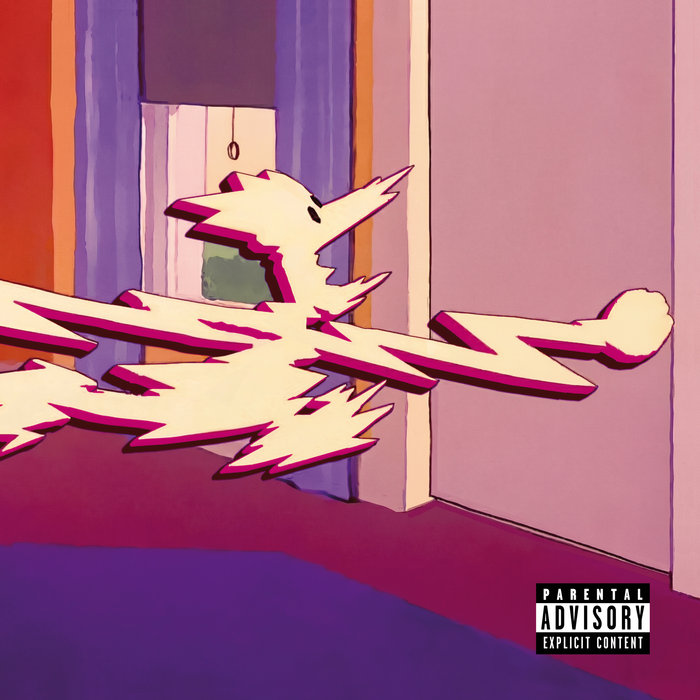
Then the third leg was my own project. I stopped the label partially because my own creative work was at a standstill. I've done some things in the interim, but it was tangential stuff, and things that I never released, actually. I finally hit a point where the work that I've been trying to do for the last decade was finally coming to fruition. I actually did shop it to some other labels and I had a little bit of interest, but I could just do this myself and be more focused on it than someone else might be. With those three things coming together, I said, we can test it out. Then we added a fourth project with People Like Us a little bit later on.
That's amazing that everything was its own thing and coalesced into this, which feels like a big deal. Even the comments on the Instagram announcement post—people are hyped for this.
Yeah. It's exciting. And hopefully we can find an audience for everything.
I don't know if this is too sausage-getting-made, but in comparison to the last time the label was active, in terms of how promotion worked, is there anything that you're trying differently? Obviously, it feels like an entirely new landscape in terms of social media.
Mostly I'm just trying to stay open to all the different possibilities. When we were operating earlier, it seemed like there was a much simpler model in place. In the case of Girl Talk, it was basically one review from Pitchfork that tilted the balance for his work. And I don't think that exists as much anymore. When it happened with Girl Talk, the floodgates just opened all of a sudden—it had been out for a little bit and I think it had had gotten some interest from some of the blogs from that time. But once the Pitchfork review hit, it was instantaneous. I think the landscape is so much more complex now, and you have to push things along with any sort of exposure.
For my own project, there's a place in Asheville, North Carolina that's doing a record release party for me. That's not going to tilt the balance, probably, but it's just another thing that'll expose my music to, I'm assuming, some pretty cool people who are really interested in music. And the more of those kind of people that you reach, that are music obsessives, the more it nudges awareness and it becomes something that you can potentially develop an audience for.
So I'd love to talk about your new music as Myth Math. In terms of assembling this EP—how do you know when a project is ready?
I work very slowly, and I iterate on things a lot. This is partly why I got so into electronic music, is that I love the process of iterating on things, you know? I'll play something and be like, I like that, but something more needs to change right here. So I'll tinker and I'll change something—how loud something is, or I'll put a filter on it, or I'll create something entirely new for that part.
And working with melody and lyrics, these were all new territories for me, because I come from a very experimental background. This parallels the development of the label—the label started very experimental, and then became more and more projects that had actual recurring rhythms. And so it took a long time where I could write lyrics that I didn't come back the next day and felt were cringey. The four tracks on the EP are things that I was able to stay with long enough to complete them. I'm really picky, I guess, and this is going to be one of the challenges moving forward—now that I have this EP out, how do I develop more material that I don't spend years on?
This Myth Math EP is also a bit different from you from your past work in that you've been collaborating with a former student, Mitchell Baker Martin.
That's correct. None of this material predates me working with Mitch. He was a student who I recognized had a very keen musical ear, and heard music very differently than I did. Which is a huge asset. A lot of experimental musicians just do everything themselves, you know? And since I was trying to move into more song-oriented material and more normal music production, I became more and more aware that a lot of production, not just mainstream production, but indie production even, has a lot of people working on it. And so I opened myself up more to the collaborative process.
I have another friend who has a lot of vintage synths. His name is Ryan Nolan. I'd go over to his house slash studio. And I mean, I teach synthesis at the university, so it's not like I don't know how to do this stuff. But he'd be like, for a bassline, we should used this vintage Pro One synthesizer that I have. The MIDI chords already existed, and so he would do a pattern around the chords. I had to let go of my desire to micromanage everything. I like that I don't need to be the sole author of everything on this track. So working with Ryan and Mitch and then also the person who did the mixing for us [Seth Boggess]—he's another student, but an older student who had a lot of professional experience already. He was a hands-on mixing engineer who also added things to it. The collaborative process became very, very important, because otherwise it probably would have been a lot more left-field sounding without a lot of other people exerting their influence on it.
Going back to Mitch. Mitch was really critical to me having confidence in the tracks, because I listen very sonically—I'm very into how it sounds. And Mitch is really into how this chord follows another chord. It's not that I don't understand that stuff or know that stuff, because again, these are things that I teach. But I don't listen to music that way. When I'm listening to an artist, I don't think, oh, wow, that's really cool how they moved from this chord to a chord substitution or to a chord that has a note that's outside of the key. I understand that stuff from a theoretical standpoint, but I don't hear it. But Mitch could hear it on the spot and tell you exactly what they're doing and why it's cool and why it sounds unique.
That's so interesting, I've never thought of the difference in listening like that. Okay, one of the songs on the EP, "Lift"—I really like the line Lift me up / Let me riff. Where did that come from?
I'd written the verse in advance, and I think it was actually Mitch that said there needs to be something that comes after after the verse—a chorus or something. And we didn't go full-on chorus, but I think that naturally flowed out. On the first verse, it just states it one time. And then I kept expanding it into more iteration, more repetitions, and then also added my wife doing harmonies. It was actually the first song we worked on, when I was super focused on doing pure songwriting without worrying about sampling or the more sound designer-ly concerns that I would normally be concerned with.
I'd wanted to create things that had more intentional meaning. Going back to the transgressive nature of sampling, or the anti-traditional nature of experimental music, both those acts rub against what people expect music to be. There's a lot of meaning in that, but I was looking for something more specific, where I had to think, what do I really want to communicate with this? And what I was trying to communicate was this general notion of the experience of life, and how all of us in life have the ability to affect each other. And to positively—not to use the words from the song—but positively lift each other up. Or in the case of "Infinity," to accept each other as we are.
So that lift me up / let me riff line—that's what I felt from the experiences that I was having when I was really young, when I had a friendship with my uncle who was closer in age to me than my parents were. He got me into music that I'd never heard before. And he also gave me confidence, and empowered me in ways that I didn't feel from my parents. Another concept I was playing with was the idea that these are love songs, but they're not romantic love songs. So "Lift" is kind of a love song for my uncle—you empowered me, you made me feel special. And then in "Infinity," I'm inverting that, where I'm trying to convey that to my son—this is a child that I was worried about at the time, but I was conveying to him everything was all right with him, despite all the difficulties he might be going through.
I love that you described these as non-romantic love songs. I feel like throughout, there's a mood of positivity—not, like, slapping a smiley face on it..."good vibes" also sounds like a weird thing to say...but it has a glow to it, good energy.
That's what I'm trying to go for, I think. And the song "Deep Down" is not about a specific person, but it's an invitation: let's go to something deep and meaningful. We're in this troubling time politically, environmentally...putting a little bit of hope out into the world that maybe we can get past some of this stuff if we—I keep using the term "lift"—if we lift each other up, and go into things that are meaningful for us, and not get so bogged down with all the negativity that's out there. Not to ignore it, I'm not trying to be like ah yeah, forget all the stuff that's going on. But no matter what happens, we still have each other, we still can find meaning in life.
You said you were inspired by your students and what they're listening to. Is there anything new and interesting that you've been listening to that you've been introduced to by younger people?
I have two sons that are in high school right now—one of them just graduated and is leaving soon. They're always playing stuff for me, which I think is nice. I do find it really refreshing. And this happens with my students as well, to hear things that I wouldn't normally listen to. One example: my sons were really into Twenty One Pilots a couple of years ago...
Mmm!
...and convinced me to go to a concert. This is a band that I'd probably just dismiss, but the concert tickets were so expensive that I was just like, okay, I'm going to have to get into this. The album at the time was Clancy. I played it multiple times leading up to the concert and I did get into it, and I learned to appreciate them. And since I was in the middle of working on my own songs, I appreciated that the songs were good. The guy's a decent songwriter—I still don't know if I can get into their earlier stuff where there's more of the nerdy white boy rap thing going on, but when I hear the earlier stuff, I can hear the seeds of some of the stuff that I heard in Clancy—I'm like, yeah, it sounds like Clancy Lite. That's probably unfair to the rest of their material...but anyway, that's a good example of something that I got into that I wouldn't have normally without my students or my children exposing me to things.
I'm happy you brought that up as an example. I feel like with Twenty One Pilots, the sentiment among the more music bloggy snobs is, like, that's corporate alternative rock. But they have some good songs. And I've never seen them live, but I've seen footage of them playing live. And it sounds like they put on a really, really good show.
Yeah. And you can tell they're thinking about their music. They're not just cranking out stuff to be part of the music machine or whatever. Even though we still may not align perfectly with how we approach music, I gained a lot of respect for them.
Thank you Matthew S! Listen to the new Myth Math EP here, and follow the Illegal Art IG for all the new projects.
Thanks for reading I Enjoy Music! If you like it, tell a friend.